Englynion on Gravestones
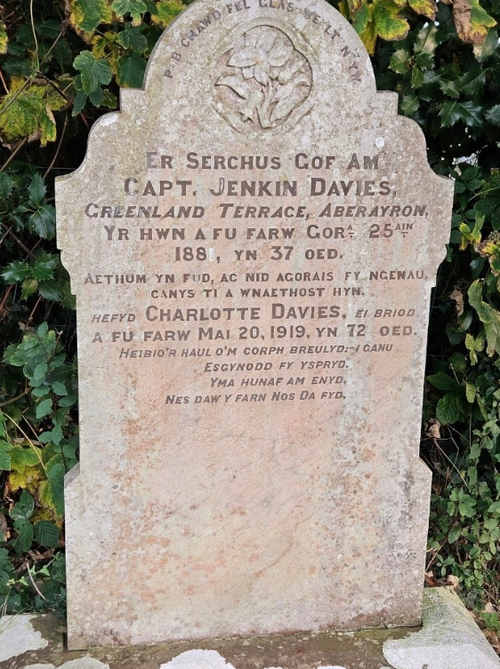
It’s a privilege to live and work in such a beautiful area. I spend my spare time basking in nature, and discovering the countryside and the coast; there’s nothing better to stimulate the senses! As well as exploring, taking photographs and watching birds, I’m also on the look-out for englynion.
Some of my earliest memories are of visiting cemeteries with my grandfather, and laying flowers on his father and sister’s graves. They were quiet places, sometimes bleak but never morbid; rather, they were places full of respect and love. For me, this custom has persisted, but I now lay flowers on my grandparents’ grave as well.
Over the last two years, I have visited a great many cemeteries across Wales, while volunteering for the Englyn Bedd project, the purpose of which is to record elegiac englynion inscribed on headstones.
There are several thousands of them across Wales, many of which have never been recorded... Many are in decline due to the ravages of time and the weather, and need to be documented and protected as a core part of the nation’s material and social culture.
The task of recording them is varied and can be affected by factors such as the condition of the stones, the weather and the nature of the daylight. Many are repeat examples, featuring on several headstones, but others offer a personal glimpse into the lives of individuals; they are powerful in their meaning and stir the soul. Recording the enchanting words of strict metre poets is an honour.
But as a hobby, it isn’t straightforward. I have frequented numerous cemeteries where headstones have toppled over, or where the epitaphs are obscured by thick layers of ivy. Others are unreachable due to damage from badgers, or saplings growing and weaving together to form natural walls. Money may be tight, resulting in a lack of maintenance, but there is a duty to ensure that these sites are in a good and safe condition, especially if they are open to the public.
The late Rev. Lyn Lewis Dafis wrote a short article entitled Englynion on gravestones. He noted a change after the 19th century, when memorials and gravestones started to be viewed as a link between living relatives and the deceased.
The Englyn Bedd project is making a concerted effort to keep that connection alive. The next step is to publish an anthology of such englynion, and work on a second collection has already begun – and I’m grateful that I’m able to contribute to them.
Emma O’Connor (Administration and Property Manager, Diocese of St Davids)