 Safeguarding
 Find a church
 Find clergy

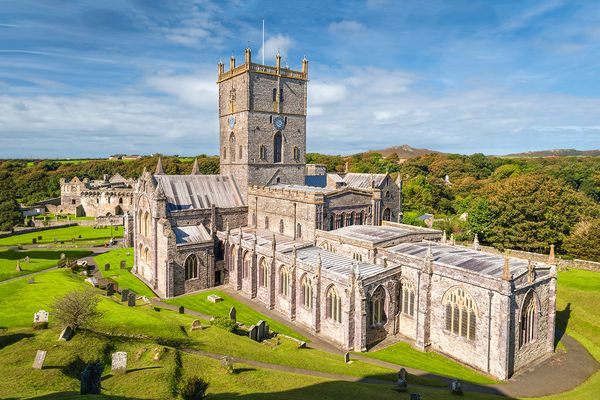
The publication of this Visitation Report marks an important moment in the life of St Davids Cathedral. A Visitation is never an end in itself; rather, it is offered as a pastoral and constructive act, intended to support, encourage, and strengthen the Dean, Chapter, staff, and wider Cathedral community in their shared stewardship of this holy place. Its purpose is to direct and encourage ministry and to enable a faithful, practical response to the very real needs of the Cathedral — financial, structural, missional, and spiritual.
St Davids Cathedral stands not only as a centre of worship for the Diocese, but as a physical and visible sign of the Christian presence in this land — locally, nationally, and internationally. It is a place of prayer and proclamation, a focus for pilgrimage, a treasure of deep historical and spiritual significance, and a living witness to the Gospel of Christ. The Visitation therefore seeks to magnify this calling, reaffirm its importance, and ensure that the structures supporting the Cathedral’s life are strong enough to sustain that witness for generations to come.
It is important to stress that this Report was compiled to assist and enable, not to criticise for its own sake. It aims to identify where encouragement, renewal, and strengthening are needed so that ministry may flourish more fully. No Cathedral — particularly one of such age, complexity, and prominence — is without challenge. The Visitation should therefore be understood as a shared opportunity for growth, rooted in faith, responsibility, and hope.
As this Visitation is now made public — having already been shared in depth with the Dean, Chapter, and Cathedral staff — it is important to note that action has already begun. In several areas, steps are being taken which are not explicitly recorded in the Report itself, but which demonstrate a positive and constructive response to its findings. Notably, the creation of an Executive Committee has already been put in place to support leadership, improve focus, and ensure momentum in addressing urgent priorities. This development reflects a willingness to engage seriously with the issues raised and to respond in a practical and timely way. It is important that this positive momentum is sustained, and that the recommendations of the Report are progressed with clarity, purpose and due urgency.
I am grateful to all the Cathedral departments for their openness, professionalism, and commitment — not only in valuing what is already being done well, but in engaging positively with suggestions for improvement. This willingness to learn, adapt, and strengthen practice is an essential part of faithful stewardship.
I wish also to express my deep and heartfelt appreciation to Chris Crooks, the Dean’s Verger, and to the entire Vergers’ team. The standard of their work is exemplary and deserving of recognition. Their loyal service adds a vital focus to the practical and ceremonial needs of the Cathedral’s liturgical life, ensuring that worship is offered with dignity, order, and care. At the same time, their vigilance in matters of safety, together with their insight in recognising and acting promptly upon the needs of the Cathedral’s fabric, has been crucial in sustaining the life of this ancient building during a demanding period. Their commitment, professionalism, and quiet dedication represent a significant strength within Cathedral life and are valued more highly than words alone can express.
The music of the Cathedral remains one of its most powerful forms of proclamation. It is, indeed, an audible expression of the love and grace of God, offered to worshippers, pilgrims, and visitors alike. The musical gifts so faithfully and skilfully presented by Simon Pearce and Laurence John are a profound credit to the Cathedral and to the worshipping community they serve.
I wish also to record my appreciation of the Education and Pilgrimage department, and in particular to offer thanks to Janet Ingram for her ministry and for her significant contribution to the outreach of Ty’r Pererin, as well as for the steady focus given to education within the life of the Cathedral. As she now enters retirement, I extend my heartfelt thanks and best wishes to her and to her husband David for the future.
I also note with gratitude the value and presence of the Cathedral library, and the care of its oversight by Mari James.
I wish also to recognise and affirm the positive engagement of the Cathedral’s senior team, who are responding constructively in support of the Dean and in addressing areas requiring attention. Their willingness to work collaboratively and to consider difficult questions honestly is a cause for encouragement. I wish to acknowledge the invaluable and thoughtful contributions of the Revd Canon Leigh Richardson and Canon Sheridan Angharad James. Their constructive suggestions and engagement throughout the Visitation process exemplify the spirit of partnership and shared vocation that this moment requires.
I am especially grateful to the Dean for her cooperation throughout this process and for her willingness to listen attentively and engage openly. I wish to affirm her continuing leadership of the Cathedral and her commitment to guiding its life and mission, and I am confident in her resolve to lead with openness, collaboration and faithful service.
I express sincere thanks to the Friends of St Davids Cathedral for their long‑standing generosity, dedication, and invaluable support. Their commitment has made, and continues to make, a tangible difference to the life and preservation of the Cathedral, and it is deeply appreciated.
My gratitude also extends to the Advisors who supported the Visitation process by listening carefully and offering expertise during meetings with individuals and groups. I wish to thank Arwel Davies and Medwin Hughes for their wise and helpful contributions.
While aspects of this Report may prompt reflection or challenge it is essential that the Visitation is read in the spirit in which it was called. The process of positive response has already begun. A recent and detailed presentation by Andrew Faulkner, Architect, and Ross Cook. Archaeologist, outlining a long-term vision for repair and preservation of the Cathedral fabric, was both inspiring and reassuring. It demonstrated that careful, hopeful, and imaginative planning for the future is not only possible but already underway.
Failure to recognise the positive developments emerging from this Visitation — or to read between the lines the appreciation of what is already being undertaken — would be to misunderstand why this Visitation was called. In the light of our Diocesan Pruning for Growth Strategy, the Cathedral, despite its historic status and national importance, was rightly invited to undergo the same prayerful scrutiny as every part of the Diocese. Such scrutiny is not a sign of failure, but of care and hope for the future.
This Visitation is therefore offered as an act of encouragement — an invitation to renewal, deeper collaboration, and faithful courage. May it strengthen St Davids Cathedral in its calling as a house of prayer, a place of welcome, a guardian of history, and a living witness to Christ’s mission in this land.
In His Service,
The Right Reverend Dorrien Davies
Bishop of St Davids