Memories of a retired Reader
'All good things must come to an end’ they say and last December, after over 30 years as a licensed Reader in the diocese, Anna Bement decided it was time to hang up her blue scarf and retire. In the first of a two-part series, she looks back.
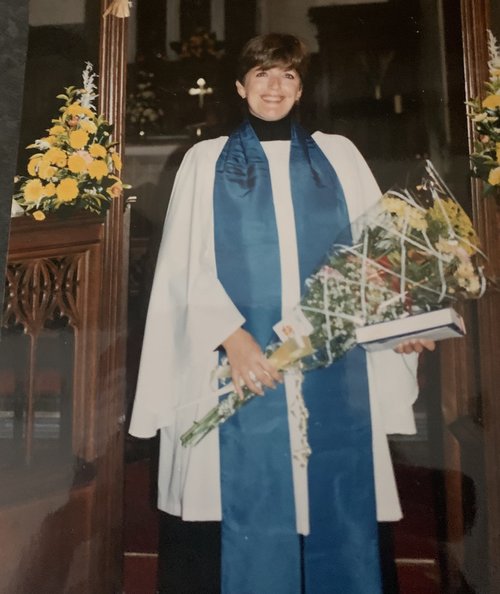
It was in September 1994 that I received my licence from Bishop Ivor and first wore that blue scarf in St David’s Church Hubberston where I delivered my first sermon.
We had just returned to Wales from Oxford where I did my long-distance training. This consisted of attending lectures and writing theological essays in the library at Wycliffe Hall where my husband Peter was studying for ordination. Since then, Reader training has, quite rightly, become much more rigorous!
The rector in Hubberston was a huge support, graciously giving me plenty of preaching opportunities and encouraging me to develop a wider ministry. This included setting up a youth group and a Women’s Bible Study as well as leading Sunday services.
When Peter was appointed vicar in the Parish of Llandeilo Fawr, my ministry really took off (being married to the vicar has its advantages!) .I was encouraged to lead and preach in a variety of services in the parish and outside – Morning and Evening Prayer, Family Services, monthly Prayer & Praise services and to, my great joy, an occasional Youth Service. This came out of a confirmation course which I ran under Peter’s guidance, and which became the GIG (Growing In God) youth group.
So what exactly is a Reader in the Church in Wales? My 1994 licence authorises the Reader to:
- Read morning and evening prayer
- Read the Ministry of the Word of the oHoly Eucharist
- Preach at the above services
- Read the Litany
- Receive and present the offerings of the people
- Publish banns of marriage
- Undertake such pastoral and educational work and give assistance to the parish priest.
All these aspects of ministry are overseen by the Warden of Readers who is always available for help and guidance. The annual Reader Conference, CMD (Continuing Ministry Development) sessions, Safeguarding Training, and an excellent magazine, The Reader, are all on offer as part of the Reader’s ongoing development and learning.
Many people think that Readers are there simply to ‘fill in’ in the absence of the incumbent, and indeed many of my Reader friends have said that sadly this is often the case. But there is so much more that a licensed Reader is allowed to do outside of worship services.
These are difficult days for the Church with priests often stretched, not only on Sundays, to meet the spiritual and pastoral needs of their people. I believe that lay ministry, and Reader ministry in particular, is part of the answer, so my hope is that this article will encourage anyone out there who may feel they have a vocation but perhaps not to ordained ministry, to test what that vocation might be.
To be continued