East and West meet: the Church of Dewi and Today
Late September saw a remarkable gathering in St Davids, with echoes of a century ago, and of Dewi’s time.
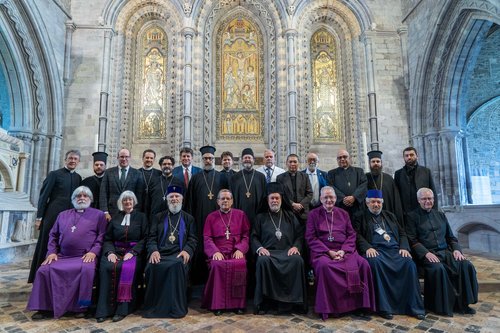
Two dozen senior clergy and theologians – archbishops, metropolitans, bishops, archimandrites, protopresbyters, canons, professors and more – came for the annual week-long meeting of International Commission for Anglican Orthodox Theological Dialogue. Travelling from everywhere from Australia to Zimbabwe, they joined Dean Sarah, herself a member of the Commission, at the invitation of the Church in Wales, with Bishop Dorrien their episcopal host.
Alongside their work of deepening Anglican-Orthodox relations and exploring shared responses to contemporary ethical questions, Commission members experienced pilgrimage to St Non’s on the coast and shared in the Cathedral’s daily rhythm of worship. This included the Sunday Eucharist, at which Bishop Dorrien presided and Bishop Michael Lewis, Anglican co-Chair of the dialogue, preached, and a sung service of Solemn Vespers for the Eve of the Feast of St Michael and All Angels.
![Anglo Orthodox [Sept 25]](https://stdavids.contentfiles.net/media/images/Anglo_Orthodox_2.width-500.jpg)
Orthodox members of the Commission led Vespers on the Feast itself, and later in the week celebrated the Divine Liturgy at the High Altar – a first. Metropolitan Athenagoras of Belgium, the Orthodox co-Chair, presided and preached, and Orthodox clergy and people travelled from Lampeter, Swansea and Cardiff for the service. Anglicans, though not able to receive the Eucharist, joined with everyone in sharing the antidoron, a large blessed and broken loaf, at the end of the service.
St Davids was deliberately chosen in this year of the 1700th anniversary of the Council of Nicaea from which arose the Creed in which Christians of East and West still share. A century ago, a similarly senior Orthodox delegation was part of a large ecumenical service in St Davids Cathedral to mark the 1600th anniversary of this touchstone of common faith. Pictures and a press account of that event were on put display.
More than this, in the time of Dewi – recognised as a saint in both East and West – our churches were undivided. Indeed, British Christianity was strongly influenced by Eastern Christian traditions. Links to Rome and Western practices only consolidated after Pope Gregory sent Augustine to convert the Anglo Saxons a decade after Dewi’s death.
Recognising the depth of this common heritage, and being able to worship and walk in the footsteps of our forebears in the faith, proved deeply moving to both Anglicans and Orthodox. The experience of standing together in this shared inheritance has left a lasting legacy on the Commission, that will help shape our deepening relationship within the unity of the Church for which Jesus Christ prayed.